
On May 4th, AMSF had another first. It was the first time AMSF had a lecture by a non-pianist. Not only did we have a non-pianist — we had a neuroscientist!
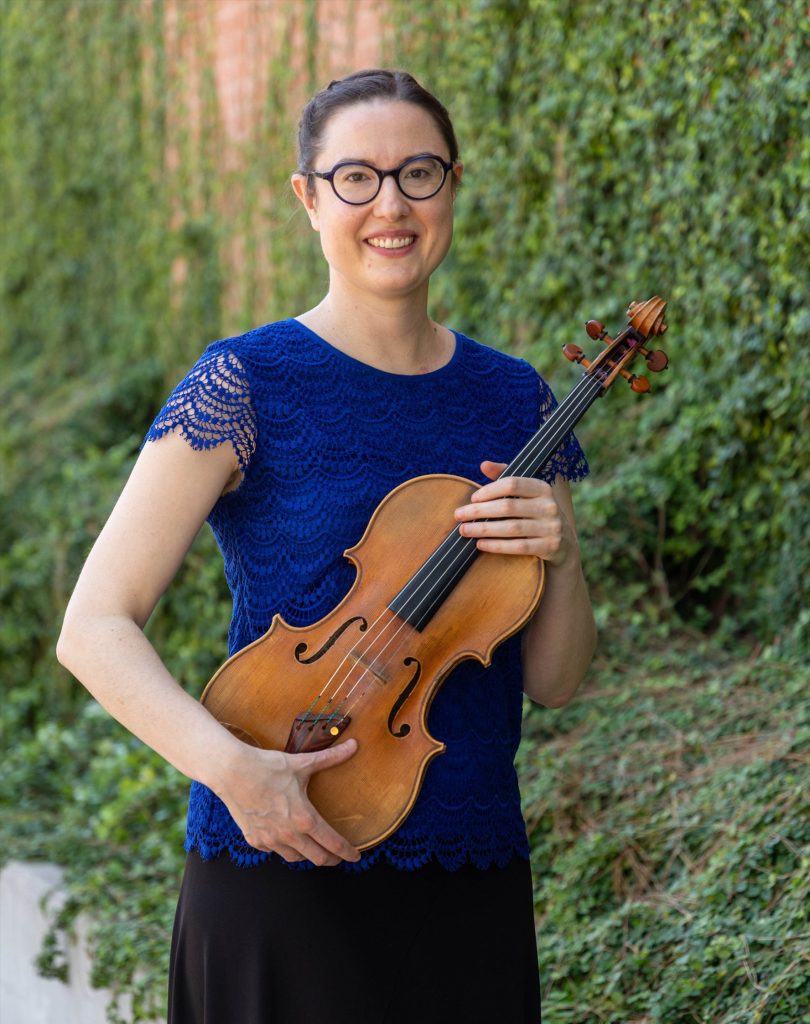
Our guest lecturer was Dr. Molly Gebrian, a vibrant young professional violist and neuroscientist with degrees from Oberlin Conservatory, Rice University and Conservatory, and the New England Conservatory. Dr. Gebrian taught music at the University of Wisconsin and the Arizona University prior to teaching at the New England Conservatory, where she teaches the Science of Practicing.
There were so many takeaways from this lecture. Some were counter intuitive, but all were backed by science. I will discuss the top two.
The first key takeaway is the use of breaks. Many students, and certainly professional musicians, were taught to practice for as many hours as they can a day. That may not be the most effective way to practice. Dr. Gebrian explained that the brain, which is like a processor, works when physical changes in the brain itself occur. That happens during breaks, not during practice. She likened this to strength training, where muscles need to undergo micro tears to grow. It is during the breaks, not during the workout, that muscles are strengthened. This is why those who engage in strength training try not to work the same muscles every day. Our muscles need to rest. In a similar way, the brain processes information at a faster speed during breaks, making breaks necessary for learning. Short practice times are more effective than large blocks of time. Dr. Gebrian recommends no more than 25-minute chunks of practice time, with 5-minute breaks. Longer breaks are recommended, the better the musician knows the piece.
Many music students, including professional musicians, were taught to practice similar sections in blocks. That, too, may not be the most effective way to learn music. Dr. Gebrian recommends interleave practice, which is, random practice. It is more beneficial for performance than block practice. Musicians suffer from the illusion of mastery when practicing in large blocks. We think we know our pieces well when we have practiced in large blocks. But how often is it the case when the day after practicing, or during performance, we forget our pieces? Our brains need to be flexible, especially during performance. We need to train our brains to be comfortable with switching all the time. Interleave practice, which is random practice, highly activates the brain, when not in performance mode. This enables the brain to be less activated and more relaxed during performance. Playing then becomes easier. Dr. Gebrian suggests switching to a different section altogether for a few minutes, after practicing for 20 minutes.
I am glad 18 members attended, mostly string players and six pianists. Hurray to all those who attended, some of whom I had not seen in any previous Special Event. I am also happy that one of our associates attended. Thank you for joining us! Please continue to do so.
Based on the comments I received, which were immediate, attendees found the lecture remarkably interesting, full of new and practical information. We will try to bring Dr. Gebrian back on a different topic at some point in the future. Hopefully, more of you will attend. Remember, only those who attend get the full benefits from our special events!