
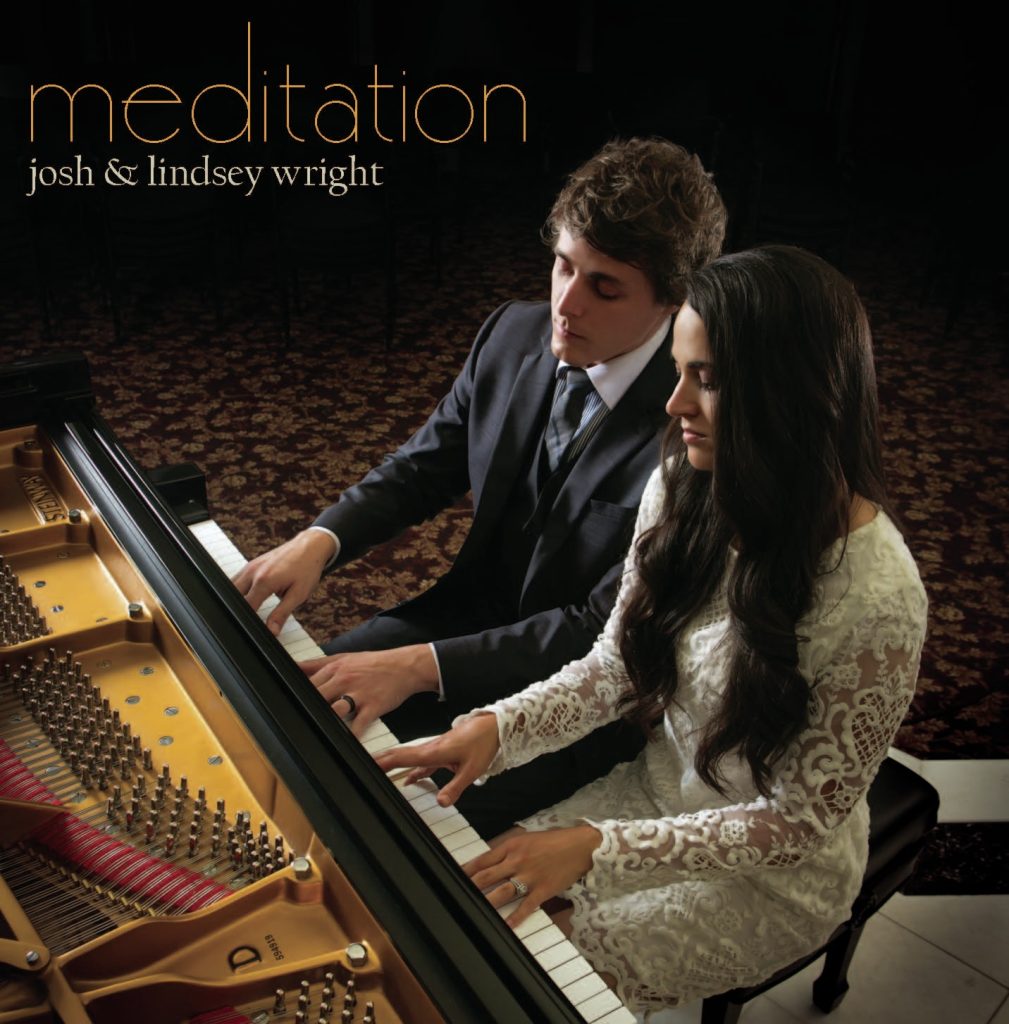
In the last two years, the number and variety of our ensembles have increased. So, we invited Drs. Josh and Lindsey Wright — professional pianists, duet partners, accompanists, and teachers — to give us a lecture on Collaborative Playing and Performing 101. Dr. Josh Wright is a concert pianist, recording artist, and piano instructor. He is an adjunct assistant professor of piano at the University of Utah School of Music and he is a listed Steinway Artist. Dr. Lindsey Wright is a pianist, singer, and violinist. They have a Christmas CD featuring their piano duos and duets together, and they have performed many concerts as a duo.
The husband-and-wife team gave us a lot of practical advice, all based on their teaching experience or their own performance experiences. We can use the tips as a checklist to prepare us for performances. Some of these tips may sound basic, but unless we have heard them, we may not be aware of them, and therefore may not be applying them. Every little act of preparation matters, so as we consistently apply these tips, our level of “performance professionalism” will hopefully improve.
Counting
- Use the metronome as a practice tool, not as a performance tool.
- Increase metronome volume (during practice) if some instruments are too loud — e.g., saxophone.
- Do not count aloud during a performance.
Performance Attire
- Make sure performance attire is comfortable. Rehearse with your performance attire.
- No heavy perfumes.
- Place music in 3-ring binders.
- Be careful with plastic protective sheets which may cause harsh reflections in certain lighting.
- Make sure the bench is at the right height.
- For four-hand arrangements, placing the two single benches perpendicularly to the piano is recommended.
- Make sure you can see and hear the other musicians as you play.
Warm-up
- Do not warm up by playing the bulk of the piece on stage with the audience listening. Arrive early to warm up.
- Adjust to the space. Have someone stand toward the back of the hall to see how the piano and other instruments project soft, medium, and loud sounds before the performance.
Tempo
- Agree on tempo and when to slow down — e.g., ritardando.
- Make sure to have the same tempo in articulated passages.
Accompanying
- Job of an accompanist: make the soloist sound good!
- Let the vocalist shine — the best piano accompanists “disappear.”
Mistakes
- Preparation is the best antidote.
- Keep calm, keep going.
- Take deep breaths — from the diaphragm as opposed to the chest.
- Do not go back and repeat.
- Identify rescue points within the piece so that in case of mistakes you can jump to them. Practice these rescue points.
Pre-performance Routine
- Eat healthy foods — e.g., blueberries, bananas, dark chocolate.
- Get your blood flowing — e.g., take a walk.
Upbeats, Alignment
- Decide who will count off — usually primo or soloist.
- Know how many beats will be counted off.
- Inaudible methods: Use the head as a signal or inhale.
Practice Sections
- Identify the climax of the piece and build it from there.
- Identify the softest point and shape the piece to that point.
Lessons
- Take joint lessons with collaborative partners — helps to identify sections where the ensemble is not together.
Mimic Different Instruments
- Listen to different media to see how various instruments sound.
Simply Too Hard
- Reduce the piece by playing the chords if the accompaniment is too complex.
- Block the chords.
Record
- When playing, one does not hear everything. Record and listen to oneself.
- Invest in a good microphone — e.g., Yeti microphone.
Page Turns
- Fold corners of music scores at different angles.
- Crinkle pages to avoid turning more than one page.
- Turn at the downbeat.
- Memorize the last few notes before the page turn.
- Write an upcoming chord at the bottom of the page.
- Consider the fold-out method.
- Consider using a Bluetooth pedal or iPad.
Pedaling
- In four-hand pieces, secondo usually pedals.
- Exception: when primo is intricate, it is advisable to switch pedaling to primo for the intricate passage and to return to secondo after
“It was an excellent program. Very helpful tips.”
“Lots of good advice. Sorry more people were not there.”