
Anne Williams, the previous AMSF Community Outreach Coordinator, lived at Raphael House Assisted Living in Rockville before she passed away in 2022, so for some of us this Home evoked special memories. Anne would have been delighted to know that there were two new AMSF members making their debut at this Outreach recital on Saturday, October 18th. Pianists Wayne Landsman and Eli Jacks joined the organization in 2025. Not surprisingly, they were the first participants to arrive. On the program there were four pianists, a flutist, a violinist, and a singalong. The recital began promptly at 3:30 p.m. with 21 residents seated in the Common Room.
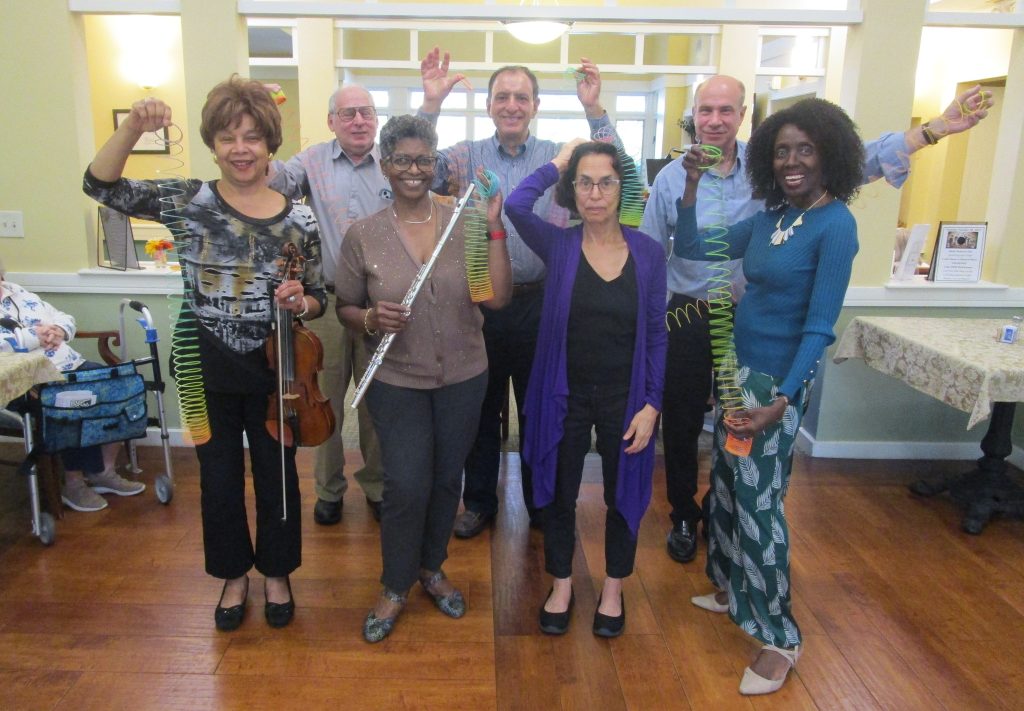
Jodi Lipson, Gregory Riviello, Carol Henry
Our first performer, Eli Jacks, made his way to the Chickering Grand piano to play the well-known Salut d’Amour by English composer Edward Elgar (1857–1934). Elgar wrote the piece for his fiancée, Alice Roberts, whose family was horrified by her intention to marry “an unknown musician who worked in a shop and was Roman Catholic.” Nevertheless, they were married in 1889. Eli’s fluid and confident playing was perfectly suited to the sweet singing melody of the piece.
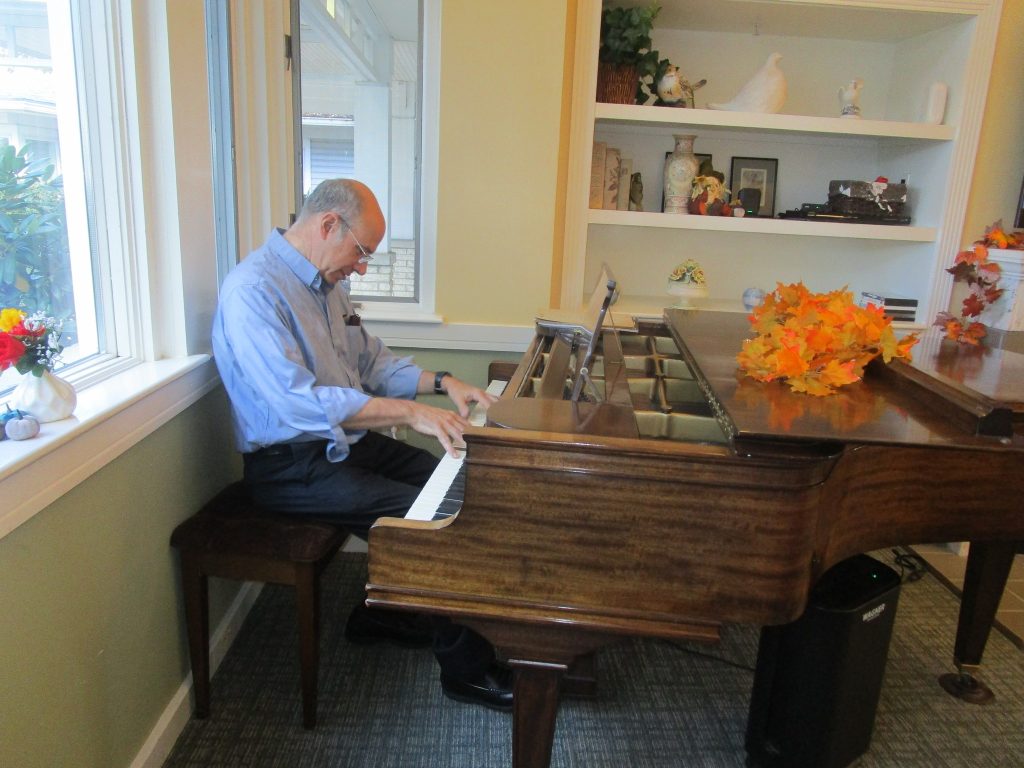
Wayne Landsman played next. His first piece was “Over the Rainbow” by American composer Harold Arlen (1905–1986) with lyrics by Yip Harburg (1896–1981). The piece was composed for the 1939 film The Wizard of Oz and was famously sung by Judy Garland. Playing from memory, Wayne added a little spice to the music when, about midway through, he suddenly shifted to a jazz rhythm that had the audience tapping their feet and humming along. His second piece was “Hi-Lili, Hi-Lo” by Polish film composer Bronislaw Kaper (1902–1983). With its upbeat ¾ meter, this song was another hit with the senior audience.
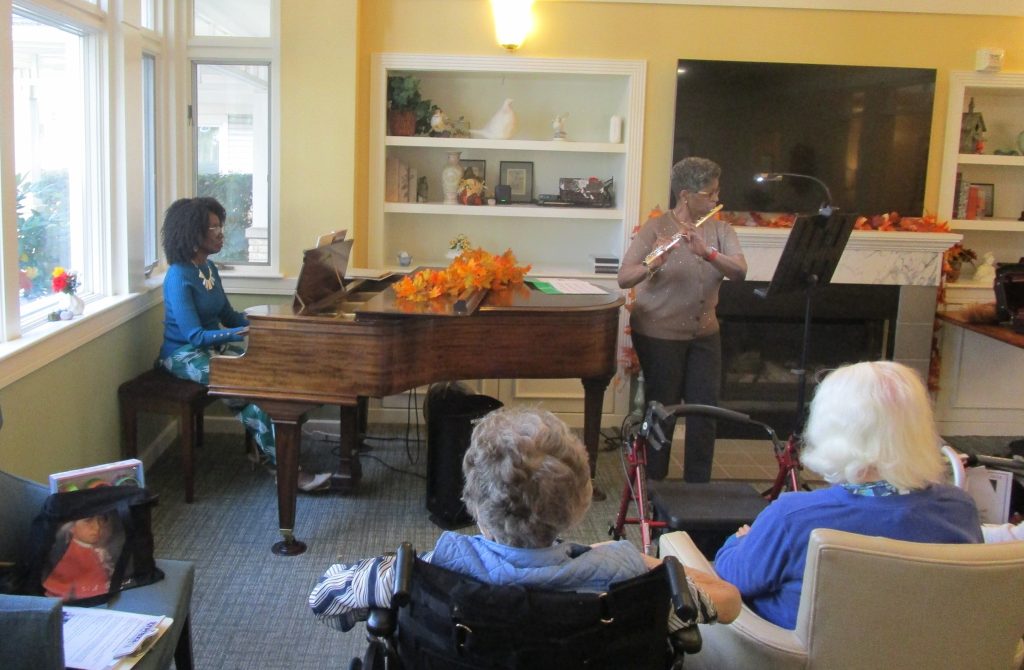
Adding variety to the program, flutist Sharon Atteh-Chi followed the two pianists with a very lively piece named “Marche” by German Baroque composer Johann Sebastian Bach (1685–1750), which was arranged by Constance Seely-Brown for solo violin. It was just as enchanting on the flute, however, as Sharon displayed her polished tone and efficient breath control particularly in the scale runs. Accompanied on the piano by Carol Henry, they kept the piece moving at a good clip and ended on a vibrant high-pitched octave that filled the room and energized the audience.
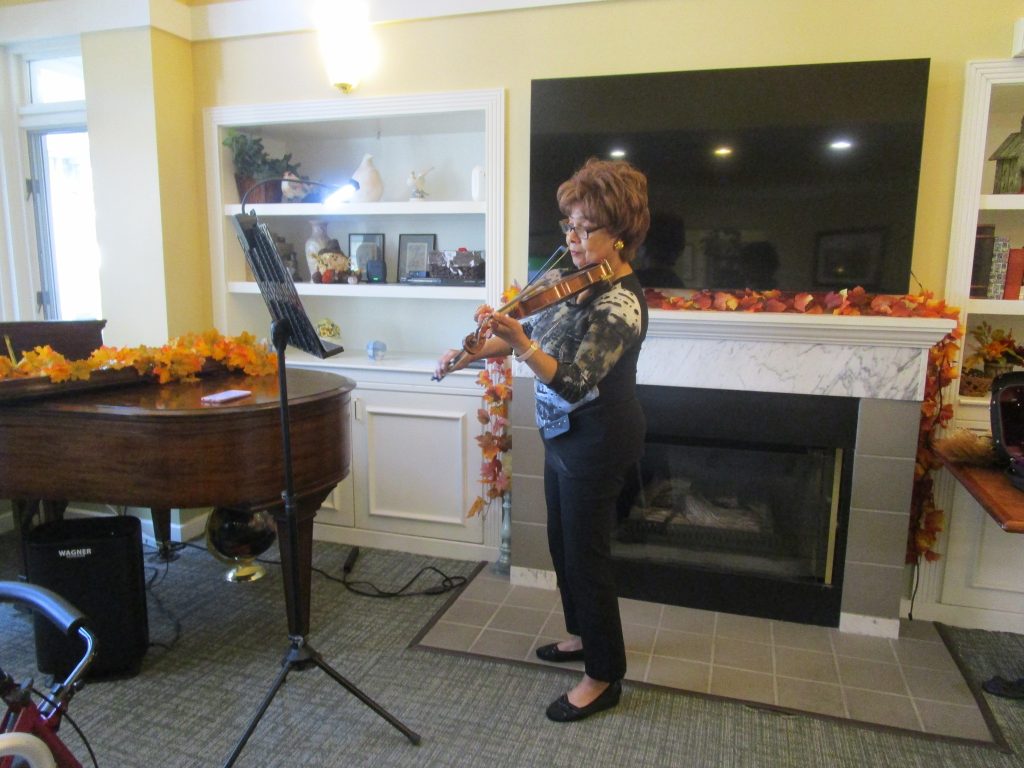
Violinist Stephanie Dailey changed the mood with three short songs. They were “Hallelujah” by Leonard Cohen (1934–2016), “Toreador Song” from Carmen by George Bizet (1838–1875), and “Ave Maria” by Franz Schubert (1797–1828). Stephanie mentioned that the “Toreador Song” was sung by a bullfighter entering the ring and boasting about his exploits and that Schubert’s “Ave Maria” (hail Mary) was one of the most famous ever written. All three pieces were very well received by the audience. Several of them seemed to know the words and began singing along as Stephanie played. It was a joy to hear their uplifted voices.
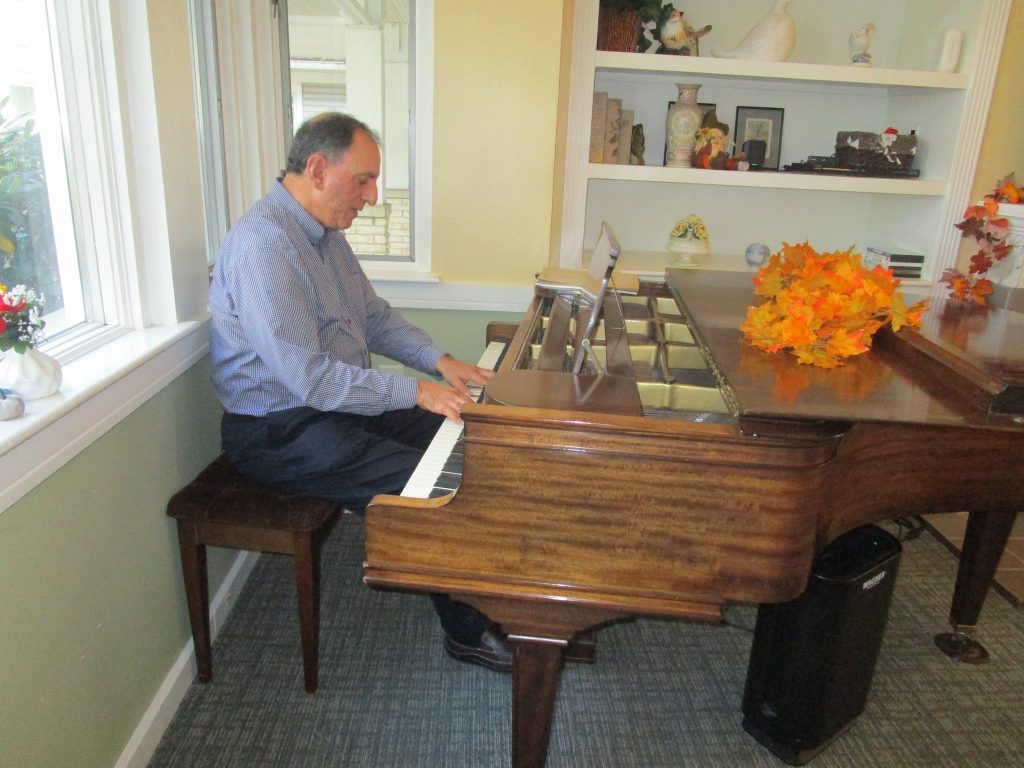
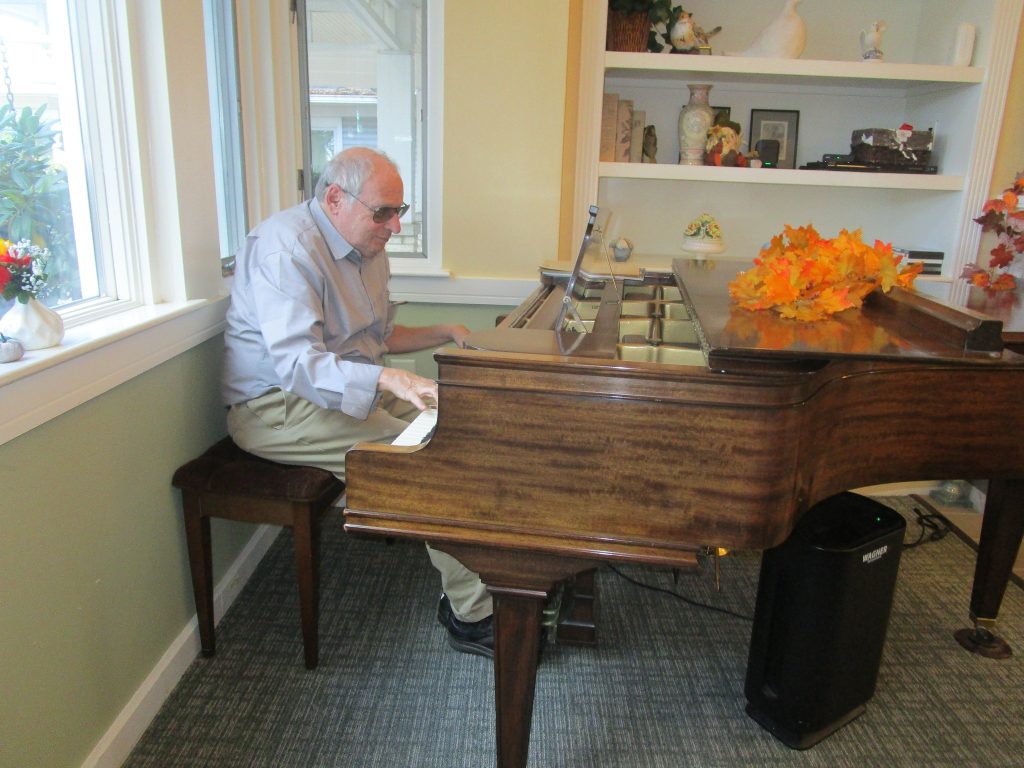
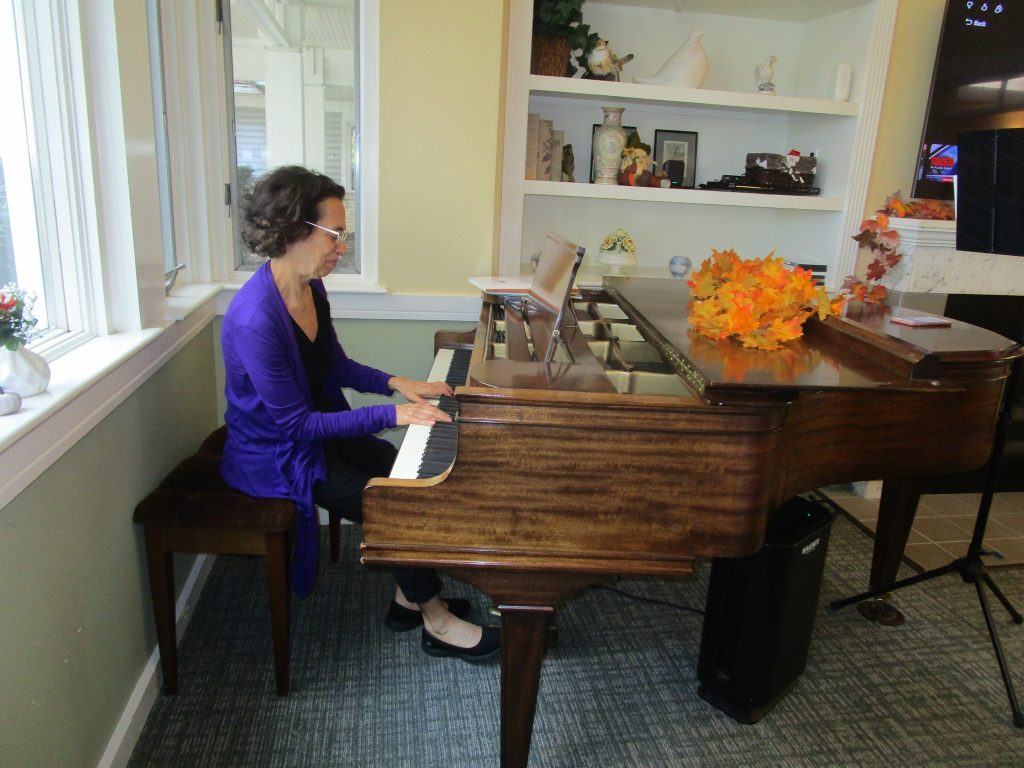
Returning to the pianists, Jodi Lipson then played Nocturne in Eb major Op. 9 No. 2 by Polish composer Frederic Chopin (1810–1849). This was one of three nocturnes that Chopin wrote when he was just twenty years old. Despite the limitations of the old piano, Jodi’s controlled and sensitive playing brought out the beauty of this piece, and she captivated the audience with the gorgeous melody. There were appreciative smiles on the faces of the residents as she played.
Gregory Riviello was the last pianist. He began with the Adagio Cantabile movement of the Pathetique Sonata Op. 13 No. 8 by Ludwig Van Beethoven (1770–1827). Its beautiful melody has been used by Billy Joel for the chorus of his 1983 song “This Night.” Gregory then played two Chopin pieces. They were Prelude in C Minor Op. 28 No. 20 (known as the “chord” Prelude) and Etude in Ab Op. 25 No. 1. Barry Manilov used the Prelude as the inspiration for his piece “Could It Be Magic,” directly incorporating eight measures of Chopin’s melody and chord progressions. The Etude was nicknamed “The Aeolian Harp,” which is an instrument played by the wind. Gregory’s mastery of the piano and versatility was evident in all three pieces as he transitioned from the serene Beethoven to the nostalgic Chopin Prelude to the lilting melody of the Etude. The Etude was particularly touching as he floated the melody above the rippling arpeggiated accompaniment in both hands. Gregory was so convincing that one would have thought there was a harp in the room.
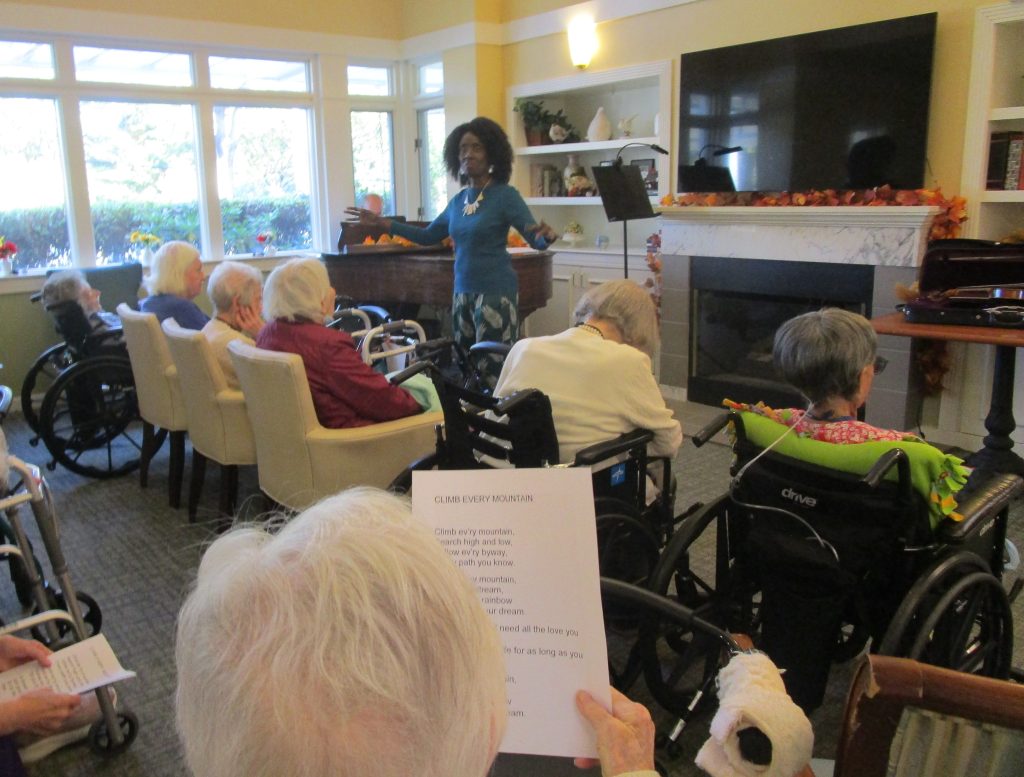
Gregory remained at the piano to accompany the final singalong led by Carol Henry. The song was “Climb Every Mountain” by American composer Richard Rogers (1902–1979) with lyrics by Oscar Hammerstein II (1895–1960). It is from the famous musical The Sound of Music. Written words were distributed, but many of the residents did not even need them! As Gregory played the melodious introduction, they were ready and came in loudly right on cue with the first verse. They enjoyed it so much that the song was repeated at the end with just as much enthusiasm. Their response definitely warmed our hearts and, after chatting with the residents and taking our group photo, we left Raphael House with a great sense of satisfaction.