

AMSF’s Allegro Master Class was held on June 9th, 2024. Celebrated pianist Brian Ganz led the class. It was an afternoon of true bliss. Allegro Master Classes are designed for advanced musicians. They provide an opportunity for members to perform and obtain feedback on their performances from an expert.
Four members of AMSF performed. Their pieces spanned compositions by Frederic Chopin, Clara Schuman, Domenico Scarlatti, and Sergei Rachmaninoff. Brain gave helpful comments and advice on how to further improve practice sessions. The Master Class ended with Brian himself performing a Chopin’s Nocturne in E minor, at the request of the audience.
Hala Tomey played Chopin’s Etude Op. 25, No. 7. Brian talked about Chopin as a storyteller. He also discussed the benefits that music theory and analytical perspectives can bring to our performances of Chopin’s works.
Carol Barth performed the Impromptu in E Major by Clara Schumann. She explained that she and her fellow music students were studying pieces written by female composers, and she chose to learn this piece. Brian highlighted the importance of exercising our ears to play cleaner sounds, including controlling the pedal’s sound, while maintaining legato.
Patrick Shea performed Sonatas K400 in D Major and K27 in B Minor by Domenico Scarlatti. Brian spoke about the role of pedaling in music composed during the Baroque era. Specifically, pedaling has three key roles, known as the “3 Cs: 1) combining, 2) connecting, and 3) coloring notes. However, in Bach’s or Scarlatti’s in keyboard music, the pedal should not be used for combining, as these pieces were written for the harpsichord. For this reason, the pedal could be better used in arpeggios rather than in scales.
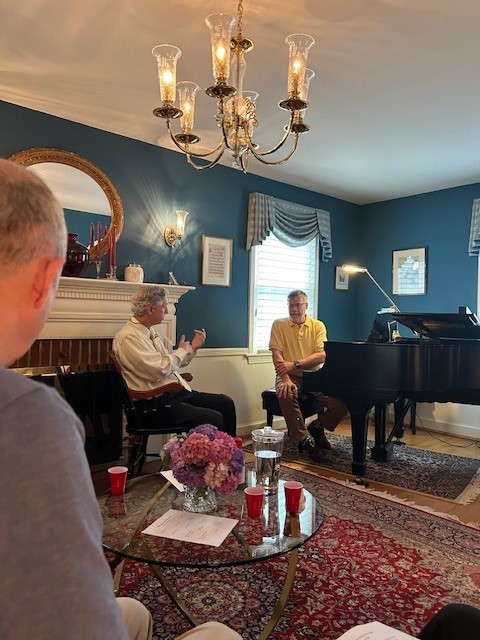
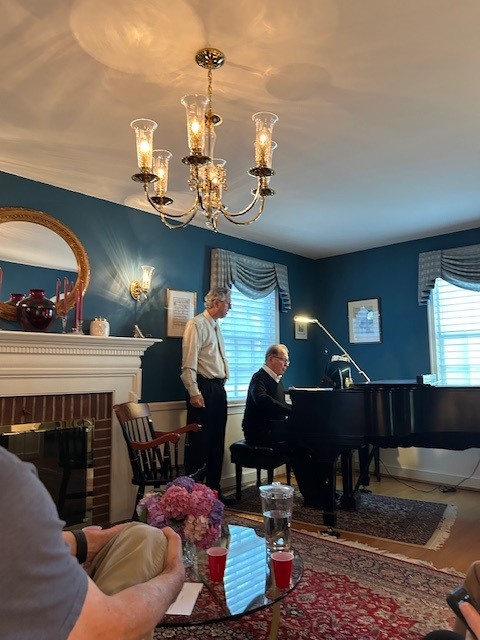
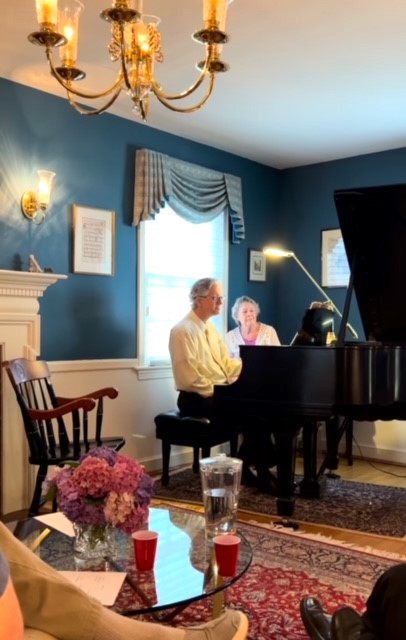
Louis Essers played Nocturne C# Minor by Frederic Chopin and Rachmaninoff’s Prelude Op. 23, No. 5. Brian discussed the importance of bringing out the melody in the nocturne, as the melody is like an aria. Brian’s comment on Rachmaninoff’s piece involved precision of the player’s fingers, not only the wrist. He recommended two exercises: 1) Hands Alone Then Together (HATT) and 2) Metronome March. These exercises help musicians to better articulate each note.
HATT exercise: take 1-2 lines of the music score, practice 1) left hand only (LH), 2) add right hand but still focusing on the left hand (LH>RH), 3) right hand only (RH), 4) add left hand but still focusing on the right hand (LH<RH), 5) practice all together with equal weight on both hands (LH+RH).
Metronome March exercise: focus on 1–2 lines of the music score at a time, playing with the metronome very slowly on the first day and building the tempo range gradually each day. For example, on the first day, start practicing at the metronome tempo of 100 BPM, gradually increasing the tempo to 116. On the second day, start at a slightly faster tempo, say 104, gradually increasing to 120. On the third day, start at a tempo of 108 increasing to 124.
During the class, the group also discussed reading material for piano techniques: Ornamentation: A Question & Answer Manual, found at https://a.co/d/d7dja5w.
Program
Etude (Op. 25, No.7) — Frederic Chopin (1810–1849)
Hala Tomey
Impromptu in E Major — Clara Schumann (1819–896)
Carol Barth
Sonatas K 400 in D Major
Sonata K 27 in B Minor — Domenico Scarlatti (1685–1757)
Patrick Shea
Nocturne C# Minor — Frederic Chopin
Prelude (Op. 23, No.5) — Sergei Rachmaninoff (1873–1943)
Louis Essers